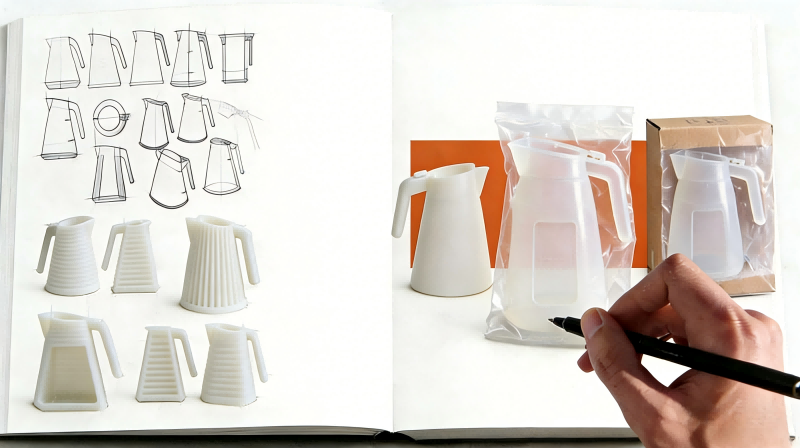
A transparent roadmap to turn your idea into a finished product—no surprises, just results.
When you are sourcing a custom plastic part from overseas, uncertainty can be one of the biggest challenges. What happens after you send your 3D file? How long will it take? Who do you talk to when questions come up?
At Ningbo Yinzhou Tuoda Plastic, we believe that clear communication and transparent processes are just as important as precision molding. Since 2008, we have refined a streamlined workflow that guides your project from initial concept to final shipment—with one point of contact, consistent quality, and no hidden surprises.
In this post, I will walk you through every stage of our injection molding process. Whether you are a seasoned sourcing professional or bringing your first product to market, this roadmap will help you understand what to expect and how we work together.
The Journey at a Glance
| Stage | What Happens | Your Involvement |
|---|---|---|
| 1. Inquiry & Quotation | We review your design and provide a detailed quote | Submit 3D files and specifications |
| 2. Design for Manufacturability (DFM) | Our engineers optimize your design for molding | Review and approve DFM report |
| 3. Tooling (Mold Making) | We build precision molds in-house | Monitor progress; approve T1 samples |
| 4. Sampling & Validation | First parts are molded and tested | Evaluate samples; approve for production |
| 5. Mass Production | High-volume manufacturing begins | Receive regular production updates |
| 6. Secondary Operations | Post-molding processes (printing, welding, etc.) | Confirm finishing requirements |
| 7. Quality Control | Parts are inspected against specifications | Receive quality reports (if requested) |
| 8. Packaging & Shipping | Products are packed and shipped | Approve packaging; track shipment |
Stage 1: Inquiry & Quotation
What we need from you:
-
3D CAD file (STEP, IGES, STL, or native format)
-
2D drawing with critical dimensions and tolerances (if available)
-
Target annual volume or order quantity
-
Material preference (or let us recommend)
-
Special requirements (food contact, flame retardant, etc.)
What we deliver:
-
Detailed quotation with tooling cost, part price, and MOQ
-
Preliminary lead time estimate
-
Material recommendations based on your application
Typical timeline: 24–48 hours after receiving complete information
Stage 2: Design for Manufacturability (DFM)
Before we cut any steel, our engineering team performs a comprehensive DFM review. This is one of the most critical steps in ensuring your project’s success.
What we analyze:
-
Wall thickness uniformity
-
Draft angles for easy ejection
-
Sharp corners (potential stress points)
-
Gate location options
-
Potential weld lines and air traps
-
Material-specific shrinkage and flow characteristics
What we deliver:
-
Formal DFM report with visual callouts
-
Specific recommendations for geometry improvements
-
Before-and-after comparisons
-
Alternative material suggestions (if applicable)
Your role: Review and approve the DFM report. We may go back and forth a few times to refine the design—all before any tooling investment.
Typical timeline: 3–7 days, depending on part complexity
Stage 3: Tooling (Mold Making)
Once the design is finalized, we begin fabricating the injection mold. This is where our in-house toolmaking expertise comes into play.
What we do:
-
Select appropriate mold steel based on your volume (pre-hardened steel for high-volume; aluminum for prototypes)
-
Machine mold components using CNC, EDM, and wire cutting
-
Assemble mold with cooling channels, ejection system, and gating
-
Conduct in-house quality checks on mold components
What we deliver:
-
Regular progress updates with photos
-
Mold trial (T1) schedule
Your role: No action required during this stage—we handle everything in-house.
Typical timeline:
-
Simple molds: 15–20 days
-
Complex molds: 25–40 days
-
Prototype molds: 10–15 days
Stage 4: Sampling & Validation
The first trial run (T1) produces the initial samples from the finished mold. This is your opportunity to validate the part against your expectations.
What we do:
-
Run first samples on our injection molding machines
-
Measure critical dimensions
-
Submit samples with inspection report (if requested)
What we deliver:
-
Physical samples (shipped via courier)
-
Sample inspection report (dimensional data, photos)
-
If issues are found: corrective action plan
Your role:
-
Evaluate samples for fit, form, and function
-
Provide feedback or approval
-
If modifications are needed, we repeat the trial until you are satisfied
Typical timeline: 3–7 days from mold completion to sample submission
Stage 5: Mass Production
After sample approval, we move into full-scale production. This is where consistency and repeatability matter most.
What we do:
-
Optimize process parameters for cycle time and quality
-
Run production according to your order quantity
-
Conduct in-process inspections at regular intervals
-
Maintain mold health with scheduled cleaning and lubrication
What we deliver:
-
Production schedule updates
-
Packing list as batches are completed
Your role: Approve final order confirmation; we handle the rest.
Typical timeline: Varies by quantity; typical lead time 15–30 days for full container orders
Stage 6: Secondary Operations
Many parts require post-molding processes to become truly finished products. We offer a full range of in-house secondary operations:
| Process | Applications |
|---|---|
| Pad printing / screen printing | Logos, instructions, branding |
| Laser marking | Serial numbers, permanent markings |
| Ultrasonic welding | Joining two plastic components |
| Heat staking | Inserting metal nuts or studs |
| Spray painting | Custom colors, soft-touch finishes |
| Plating / vacuum metallization | Metallic finishes |
| Flocking | Brush surfaces (cosmetic brushes, cleaning tools) |
| Assembly | Multi-component assembly, kitting |
| Custom packaging | Blister packs, clamshells, retail boxes |
Your role: Confirm which secondary operations are required; approve packaging samples if applicable.
Stage 7: Quality Control
Quality is not a final step—it is built into every stage. However, we conduct final inspections before packaging to ensure every part meets your specifications.
What we do:
-
First article inspection (FAI) for production start
-
Random sampling per AQL standards
-
Functional testing (if applicable)
-
Final visual inspection before packing
What we deliver:
-
Quality inspection reports (upon request)
-
Traceability records for critical parts
Your role: You may request specific inspection criteria or third-party testing.
Stage 8: Packaging & Shipping
The final step is getting your product safely to its destination.
What we do:
-
Package per your specifications (poly bags, blister packs, cartons, pallets)
-
Apply labels and barcodes as required
-
Coordinate shipping (air, sea, or express courier)
-
Provide shipping documents (commercial invoice, packing list, bill of lading)
What we deliver:
-
Tracking information
-
Shipping notification with estimated arrival date
Your role: Confirm shipping method; provide customs clearance information if needed.
Why Choose Tuoda Plastic for Your Injection Molding Projects?
-
One point of contact: You work with a dedicated project manager who handles everything from DFM to delivery.
-
In-house capabilities: We do not outsource tooling or secondary operations—your project stays under our roof.
-
Transparent communication: We provide regular updates with photos and videos so you always know where your project stands.
-
No surprises: Our detailed DFM process catches issues early, saving you time and money.
-
Proven track record: Since 2008, we have successfully delivered thousands of custom injection molding projects to clients worldwide.
Ready to Start Your Project?
Whether you have a finalized 3D file or just a concept sketch, we are ready to help you navigate the journey from drawing to delivery.
Let’s turn your idea into reality.
-
Email: contact@tuodaplastic.com
-
Phone: +86 135 8686 8074
-
Location: Ningbo, Zhejiang, China